


For decades, if you needed power at a site with no grid connection — a mine, a construction camp, a remote village, an oilfield pad — there was really only one answer: a diesel generator. It's simple, it's fast to deploy, and everyone knows how it works. But as fuel costs climb and off-grid power demand grows, a different question is coming up more often in project planning conversations: what does a hybrid energy storage system actually change, and is it really a better fit than the diesel setup everyone already knows?
This comparison matters more this year than it has in a while. In South Africa, the Minerals Council reported that the mining sector's average monthly fuel expenditure rose from roughly R2.9 billion in 2025 to about R4.0 billion by April 2026 — a roughly 38% year-on-year jump — driven by pump prices that climbed sharply within a single month. Globally, wholesale diesel prices rose about 42% over five months in 2026 even as crude oil prices fell, a gap driven by refinery constraints rather than the headlines most people track. For remote sites specifically, the all-in cost of diesel power — once fuel transport, storage losses, and generator inefficiency are factored in — can run $0.80 to $1.00 per kWh, several times the grid rate in most countries.
That backdrop is exactly why hybrid solar-plus-storage systems are showing up more often in remote and off-grid project discussions — not as a replacement for diesel entirely, but as a way to change diesel's role.

Before comparing solutions, it's worth being specific about what actually goes wrong with diesel-only power at remote sites, since these are the pain points that hybrid systems are designed around:
High and unpredictable fuel cost. Diesel purchase and transport costs are exposed to global price swings, and generator fuel efficiency is inherently limited — none of which improves with time.
Reliability and maintenance burden. Diesel gensets running as the sole power source have relatively high failure rates, and maintenance logistics at a remote site are slow and expensive.
Environmental and operational friction. Constant noise, direct exhaust emissions, and 24-hour on-site staffing requirements all add cost and complexity that doesn't show up on the fuel invoice.
No flexibility for variable loads. A generator running as the sole source has to be sized for peak load even though most sites run well below peak most of the time — an inherently inefficient way to size a power system.
None of this means diesel is a bad choice — it's still the fastest option to deploy, and for very short-term or low-budget projects it remains hard to beat on simplicity. But these are exactly the gaps a hybrid energy storage system is engineered to close.
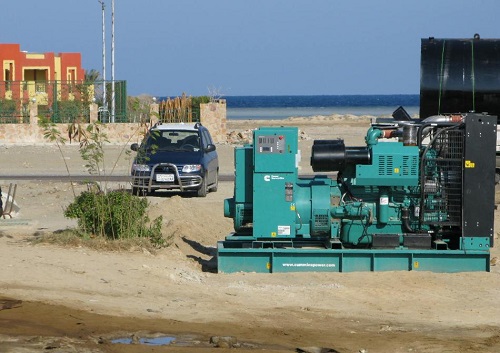
A hybrid ESS doesn't necessarily remove diesel from the picture — it changes its job. Instead of running as the primary power source, diesel becomes backup, while solar and battery storage handle the bulk of daily demand. The practical differences show up in a few specific ways:
Smarter energy sequencing. A well-designed EMS follows a clear hierarchy: prioritize solar consumption first, use battery storage to smooth demand peaks and valleys, and only bring diesel online when both are insufficient — with millisecond-level automatic switching between sources so the load never notices the transition.
Lower full-lifecycle cost, not just lower fuel cost. The cost advantage of a hybrid system isn't only about burning less fuel. It shows up across three areas: energy savings from maximizing solar utilization and cutting fuel spend, operations savings from lower failure rates and remote, largely unattended monitoring instead of constant on-site staffing, and asset savings from higher-grade protection design that extends equipment lifespan. Taken together, this is the logic behind evaluating total cost of ownership rather than comparing sticker prices — a system with a higher upfront cost can still come out ahead once fuel, maintenance, and staffing costs are counted over the full project life.
Reduced on-site burden. Remote, unattended operation with real-time monitoring and self-healing fault response means a hybrid system doesn't need the same round-the-clock human presence a diesel-only setup typically requires, which matters most for sites where finding and keeping skilled technicians is genuinely difficult.
Better resilience to harsh conditions. For sites facing corrosion, dust, temperature extremes, or high altitude, purpose-built outdoor hybrid systems (rated for conditions like IP54 ingress protection and C3-grade corrosion resistance) are designed to keep running reliably where standard equipment struggles.

In one project scoping exercise our team worked on for an off-grid infrastructure site in Africa — covering a quarry, a concrete production area, and a project camp, in a region with excellent solar resource — introducing a solar-plus-storage system alongside the site's existing diesel generators cut overall diesel consumption by more than 90%, with diesel retained purely as backup for periods when solar and storage weren't sufficient. That kind of fuel-displacement result is a good illustration of what the "solar-first, storage-for-peaks, diesel-as-backup" logic looks like when applied to a real, high-solar-resource site — even though the specific financial payback period for any given project depends heavily on its duration, local fuel pricing, and how the system is sized.
The honest framing is this: a diesel-only setup still makes sense for very short-term deployments, tight budgets, or situations where speed of deployment matters more than anything else. A hybrid energy storage system makes more sense as the operating duration gets longer, as local diesel costs and logistics get more expensive, and as the site's reliability and staffing constraints become harder to manage with a diesel-only approach. For most mining operations, extended construction projects, remote villages, and other long-duration off-grid sites, that combination of factors is exactly why hybrid systems are becoming the more common choice.
Injet's HanCang series of extended-range hybrid energy storage systems is built specifically around this comparison — engineered with the "solar-first, storage-peak-shaving, diesel-backup" EMS logic, IP54 and C3-grade outdoor protection, and remote unattended operation designed to reduce exactly the cost and reliability gaps that a diesel-only setup runs into over time.


HanCang 261kWh HanCang 522kWh
Q: Is a hybrid energy storage system meant to replace diesel generators entirely?
A: Not necessarily. Most hybrid systems retain diesel as a backup power source rather than removing it — the goal is to shift diesel from being the primary source of power to a standby role, with solar and battery storage handling most day-to-day demand.
Q: What are the main downsides of a diesel-only power setup?
A: High and unpredictable fuel costs, higher equipment failure rates with complex remote maintenance, noise and emissions, and the need for continuous on-site staffing — none of which improve as the project runs longer.
Q: Does a hybrid energy storage system cost more than a diesel generator?
A: Typically, yes, in upfront equipment cost. The comparison that matters is total lifecycle cost — factoring in fuel, maintenance, and staffing savings over the project's duration — rather than just the initial purchase price.
Q: How much can a hybrid system actually reduce diesel consumption?
A: It depends heavily on local solar resource and system sizing, but in strong solar regions with well-designed systems, diesel consumption reductions well above 90% have been achieved in real project scoping work, with diesel retained purely as backup.
Q: When does it still make sense to use diesel-only power?
A: For very short-term deployments, tight budget constraints, or situations where deployment speed outweighs other considerations, a diesel-only setup remains a reasonable and simple choice.
Diesel and hybrid energy storage aren't really competing for the exact same job — they solve the remote power problem in different ways, at different costs, over different timeframes. Understanding which one actually fits your project starts with an honest look at how long you'll be running the site and how much diesel really costs to get there — not just which piece of equipment has the lower price tag on day one.
Trying to figure out whether a hybrid energy storage system makes sense for your site? Contact Injet New Energy to talk through your load profile and site conditions with our engineering team.