


The global microgrid market is expanding at an unprecedented pace. Valued at USD 43.47 billion in 2025, it is projected to reach USD 95.16 billion by 2030, growing at a CAGR of 17.0%. Much of this growth is driven by demand for a reliable hybrid energy storage system that can replace diesel-only power in remote and harsh environments — from mining operations to construction sites to oil and gas fields.
But not every hybrid energy storage system is built for real outdoor conditions. This article breaks down what sets the INJET HanCang hybrid energy storage system apart — and why that difference translates directly into lower costs, less downtime, and faster project delivery.

The microgrid market is broadly segmented by power output: small-scale (under 125kW), medium-scale (125kW–2MW), and large-scale (over 2MW). Many suppliers only offer the extremes — undersized residential-style units, or oversized utility-scale systems that come with unnecessary capital expense.
The HanCang series occupies the medium-scale sweet spot: 125kW to 2MW — precisely the range that covers the majority of commercial and industrial outdoor power needs.
Why this matters: You get a hybrid microgrid system powerful enough to run heavy equipment, camps, and processing facilities, without paying for capacity you'll never use.
Many medium-scale hybrid energy storage systems on the market are simply indoor systems repackaged for outdoor use — never designed from the ground up for a desert oilfield or a high-altitude mining camp.
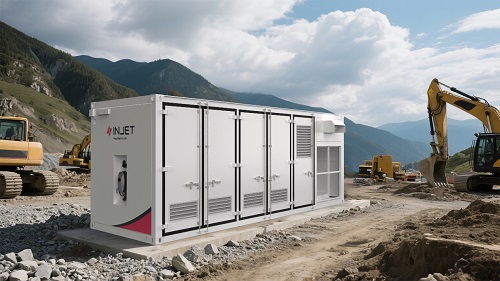
The HanCang containerized energy storage system uses an "outdoor-specific + modular" architecture. Every unit is pre-assembled and fully integrated at the factory, with layered hardware for easy field servicing.
Why this matters: A forklift or crane positions the unit and it's ready to run — no on-site assembly, no months-long civil works. Deployment time compresses from months to under a week.
Generic microgrids assume balanced loads and stable environments. Outdoor project sites are the opposite: heavy machinery causes load swings, camps have unpredictable day-night power cycles, high-altitude mining sites face thin air and temperature extremes, and coastal sites face salt corrosion.
The HanCang industrial energy storage system is hardened for these realities:
· Three-phase unbalanced load tolerance — no derating or shutdown from uneven site loads
· 2x short-term surge capacity — handles motor and pump start-up spikes
· Wide temperature range — operates from -20°C to 50°C
· C3 corrosion protection (upgradable) + IP54 rating — built for salt fog and dust
· High-altitude readiness — reliable operation up to 4,000 metres
Why this matters: Your power system doesn't fail when conditions get tough — keeping your project on schedule.

HanCang energy storage system operating in high-altitude mining environment
Most energy management systems (EMS) are built for steady commercial or residential loads — not the 24-hour cycling of an active project site.
The HanCang off-grid hybrid power solution runs on a proprietary EMS algorithm developed specifically for outdoor site operating patterns. It coordinates solar PV, battery storage, and diesel generation — prioritizing solar, using storage for peak shaving, and keeping diesel as backup rather than the primary source.
Why this matters: Higher renewable utilization means less diesel burned, lower fuel costs, and fewer deliveries to remote sites — without compromising reliability.

Many medium-scale systems offer basic monitoring only — when something breaks, you still need to dispatch a technician and wait days or weeks.
The HanCang cloud-based platform is built for unattended microgrid operation, with four core capabilities:
· Active fault warning across voltage, temperature, SOC, and SOH
· Remote parameter adjustment from anywhere in the world
· Automatic self-healing from certain fault conditions
· Full lifecycle data traceability for performance optimization
Why this matters: One engineering team can manage multiple remote sites from a central control room — dramatically lowering operating costs and increasing uptime.
The medium-scale microgrid market is polarized between low-cost fixed-function systems and fully bespoke solutions with premium pricing and long lead times.
HanCang uses a standardized mass-production architecture for fast delivery, while still allowing configuration adjustments for load profiles, site conditions, and project-specific tender requirements.
Why this matters: You get a system tailored to your site's needs, without paying custom-build premiums or waiting months for delivery.
A: A hybrid energy storage system combines solar PV, battery storage, and (typically) a diesel generator to power remote or off-grid sites such as mining operations, construction projects, and oil and gas fields — reducing diesel consumption and improving power reliability.
A: Most commercial and industrial outdoor sites fall into the 125kW–2MW medium-scale range, which covers heavy equipment, camps, and processing facilities without the cost of oversized utility-scale systems.
A: A fully pre-assembled containerized system like HanCang can typically be positioned and running within days, compared to months for systems requiring on-site assembly.
The difference between a generic hybrid energy storage system and one engineered for outdoor project conditions isn't just technical — it's financial. From the right-sized power rating to the smart EMS algorithm, from containerized deployment to cloud-based remote operations, every design choice in the INJET HanCang hybrid energy storage system is built to keep power flowing reliably on your site.
Ready to power your next mining, construction, or oil & gas project? Contact Injet New Energy today to get a customized HanCang configuration and quote tailored to your project's load profile and site conditions.